

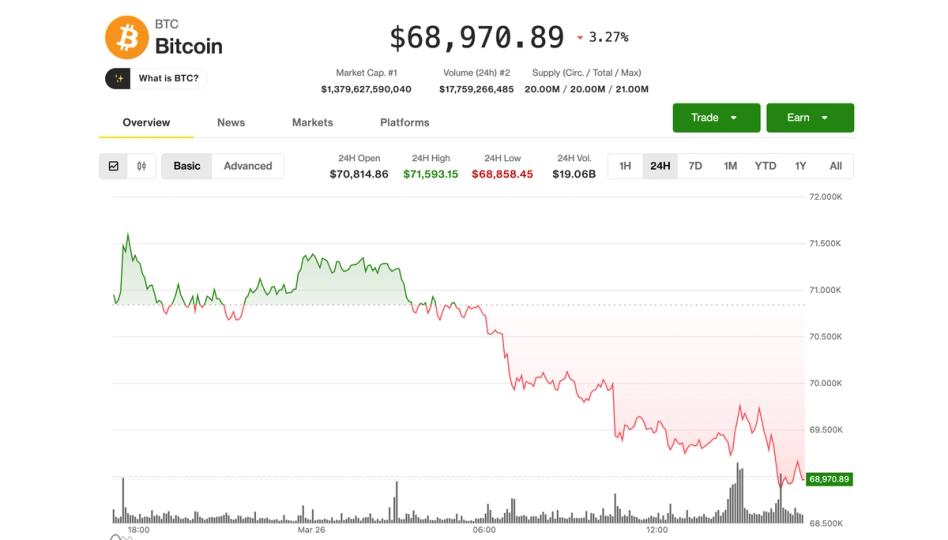
The Current Landscape of Bitcoin: A Shift Below $69,000
Bitcoin has recently experienced a notable downturn, slipping below the critical $69,000 mark. This shift has occurred against a backdrop of broader financial market fluctuations, where the earlier optimism surrounding potential peace talks between the U.S. and Iran is waning. As tensions in the Middle East cool, investors seem to be recalibrating their risk appetites, leading to a pullback across various asset classes, including cryptocurrencies.
Price Movements in the Crypto Sphere
Over the past week, Bitcoin’s price has plunged by more than 3% from an overnight high that briefly surpassed $71,000. This downturn is reflective not just of Bitcoin’s volatility but also highlights a wider trend among major altcoins. For instance, Ethereum (ETH), XRP, Solana (SOL), and Cardano (ADA) have all followed suit with declines between 4% to 5%. This simultaneous drop underscores growing investor caution in the crypto market, as altcoins frequently mirror Bitcoin’s movements.
Oil Prices: A Major Influence on Market Sentiment
As Bitcoin and other cryptocurrencies face headwinds, oil prices have emerged as a barometer for the broader financial landscape. Recent reports indicate that crude oil futures rose nearly 4%, rebounding from prior losses. This spike has raised concerns around inflation and supply chain disruptions connected to the ongoing tensions in Iran. Higher oil prices typically worsen inflationary pressures, prompting investors to shift their focus away from riskier assets like cryptocurrencies.
The Impact on U.S. Stock Markets
The stock markets, particularly the Nasdaq, have mirrored the crypto downturn, with a 1.4% decline noted just past noon on the East Coast. Rising U.S. Treasury yields further complicate matters, as the 10-year Treasury bond climbed 7 basis points to 4.40%. Higher yields generally exert pressure on growth stocks, leading to widespread losses across the tech sector.
Among the “Magnificent Seven” tech stocks—NVIDIA, Meta, Amazon, Alphabet, Microsoft, Tesla, and Apple—each has now seen double-digit percentage drops from their all-time highs. For instance, NVIDIA has fallen by 18%, while Microsoft has observed a hefty decline of 34%. These losses instill caution among investors, who are reevaluating their allocations in both stocks and cryptocurrencies.
Expert Perspectives on Market Direction
Market strategist Joel Kruger from LMAX Group offers insight into the prevailing sentiment, stating that the near-term trajectory of similar risk assets, including Bitcoin, will likely remain closely tied to macroeconomic developments. A potential easing of tensions could provide a much-needed boost to risk assets. In contrast, ongoing uncertainty may trap them in a "choppy range," resulting in more volatility in the weeks to come.
The State of Crypto-Related Stocks
As Bitcoin faces downward pressure, crypto-related stocks are not faring any better. Companies like Coinbase (COIN), Circle (CRCL), and MicroStrategy (MSTR) are all experiencing declines of approximately 3% to 4%. The sharpest losses, however, are among Bitcoin mining companies, many of which have pivoted to emphasizing AI infrastructure, adding a layer of complexity to their valuations.
The mining firm Hut 8 (HUT) has dropped by 8.6%, while others like IREN and Riot Platforms (RIOT) have seen losses exceeding 7%. Notably, firms like TeraWulf (WULF) and HIVE Digital (HIVE) have posted significant downturns as well, indicating a tough environment for mining operations driven by both rising operational costs and falling crypto prices.
Divergent Paths: Some Stocks Are Bucking Trends
Interestingly, not all companies are suffering in this turbulent environment. Marathon Digital Holdings (MARA) reported an 8.7% rise in its stock after announcing a substantial sale of $1.1 billion in Bitcoin to tackle its debt burdens. Such strategic moves provide a glimpse into the potential opportunities that can arise even amidst market volatility, suggesting that some companies are adeptly navigating these uncertain waters.
The Broader Implications for Investors
As Bitcoin and its associated ecosystem grapple with recent shifts, investors are left to ponder the implications of these developments. The intertwining of geopolitical concerns, inflationary pressures, and significant drops in stock prices create a complex web of influences on both traditional and digital asset markets. Understanding these dynamics will be crucial for making informed investment decisions as this landscape continues to evolve.
The ongoing fluctuations in Bitcoin’s price reflect broader trends in financial markets, punctuating the inherent volatility of cryptocurrencies and the interconnectedness of global economic factors. Investors must stay informed to navigate this ever-changing environment.