

The Rapid Evolution of Artificial Intelligence: An Exponential Journey
Artificial intelligence (AI) is evolving at a pace that many struggle to comprehend. Once distinguishable from human creations, AI outputs across music, text, coding, and imagery increasingly blur the line between machine and person. What was once a reliable distinction is now evaporating, sparking discussions about the true potential and pitfalls of AI technologies.
Despite their remarkable capabilities, AIs are not without flaws. They can often produce misleading information, misinterpret instructions, or lack the nuance required for certain tasks. While they entertain us as innovative toys, their utility as dependable assistants remains questionable. This duality leads to a pressing inquiry regarding how to contextualize AI’s growth: Is it just a technological fad, or is it the most pivotal advancement since smartphones or even the industrial revolution?
Evaluating AI’s Growth Through Benchmarks
To understand the progression of AI, experts often rely on industry-standard benchmarks that assess the competencies of various models. These statistical measures have shown rapid improvements, particularly highlighted by recent advancements like Google’s Gemini 3, which reportedly exceeded previous performance records. However, a critical observation made by AI experts, such as Marc Warner from the British tech company Faculty, is that while benchmarks provide a snapshot of ability, they may not capture the broader implications of growth.
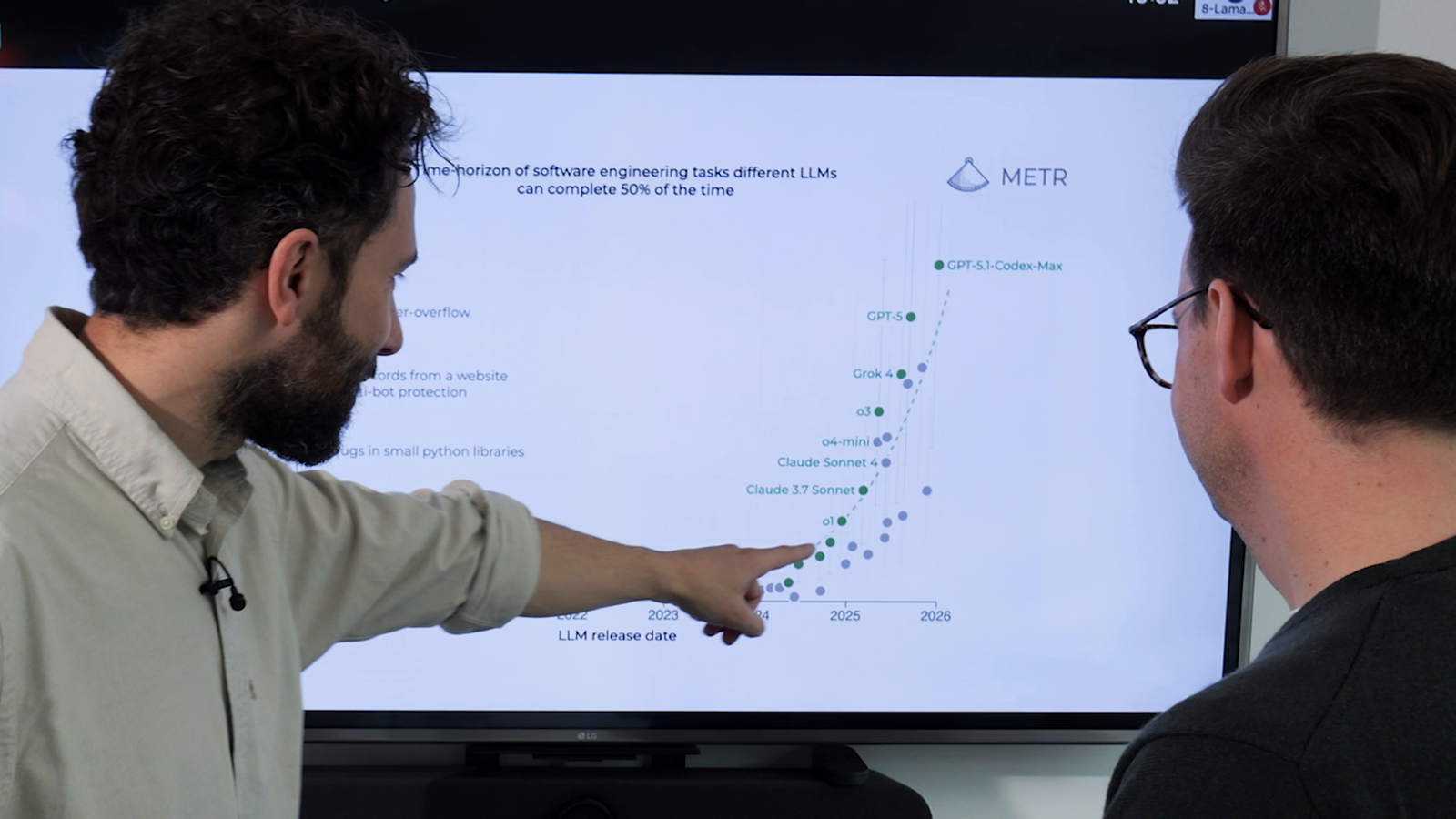
Warner emphasizes the importance of zooming out to identify overarching trends. When examined from this perspective, one sees "a very strong exponential." This pattern indicates that growth is not linear; rather, it doubles consistently, creating a steep upward trajectory. The phenomena can be encapsulated in the phrase, “Nothing, nothing, nothing, everything,” which resonates with those who witnessed the sudden onset of the COVID-19 pandemic—an exponential growth model that caught many unprepared.
The Parallel Between AI and COVID-19
Just as COVID-19 rapidly escalated, Dr. Warner cautions that AI could follow a similar trajectory, and he expresses concern over our preparedness to handle such a shift. If AI continues to proliferate as it has, its impact could dwarf that of the pandemic. For Warner, the major difference lies in permanence: while COVID might have been a transient disruption, AI signals a deeper, perhaps enduring transformation in our operational landscapes.
When Will AI Reach Its Limits?
Warner, with a background in physics, draws parallels from his experience during the COVID crisis. Back in March 2020, he was already analyzing data to forecast the pandemic’s escalation faster than governmental bodies recognized. Together with his brother Ben, they communicated these alarming projections to key decision-makers, culminating in the swift lockdown measures adopted by the UK.
In contemplating the future of AI, Warner believes it cannot continue its exponential growth indefinitely. Eventually, the energy demands to train increasingly complex models will become unsustainable. He mentions that the effort to train AI could exceed all available energy on the planet, hinting strongly that there must be a ceiling to its progress. Despite this ceiling, the data suggests that AI capabilities may double every seven months for the next several years, indicating significant changes on the horizon.
The Positive and Negative Impacts of Technological Shifts
Anticipated developments from AI promise a mixed bag of outcomes. While some results are likely to be beneficial, significant disruptions are also expected. Warner underscores the importance of proactively planning for these shifts. "As with any new technology, there will come a bunch of disruptions," he notes, urging stakeholders to consider both the potential and the risks associated with AI.
Despite uncertainties, he believes the government is semi-prepared, highlighting recent initiatives like the sovereign AI fund and the establishment of the UK’s AI Security Institute, which investigates associated technical risks. However, there’s still much ground to cover in forging a comprehensive plan.
Navigating the Future with Caution
In the broader panorama of AI, uncertainty reigns, mirroring the unpredictability of the pandemic. AI’s potential was often assessed through narrow scopes, making it difficult to draw broad conclusions regarding its overall capabilities. Economic factors add another layer of unpredictability, as speculation surrounding AI products gives rise to bubbles that may or may not reflect the actual technological advancements occurring.
Suddenly transitioning from early stages to advanced iterations of capabilities, Warner likens the leap from initial aeronautics to something akin to the Concorde in a very compressed timeframe—an impressive and significant evolution with much more likely to emerge. The journey of AI is far from over, and as advancements continue to unfold, one cannot help but wonder: just how far can this remarkable technology go?



