

Escalating Trade Tensions: A Closer Look at the U.S.-China Economic Standoff
Major Market Reactions
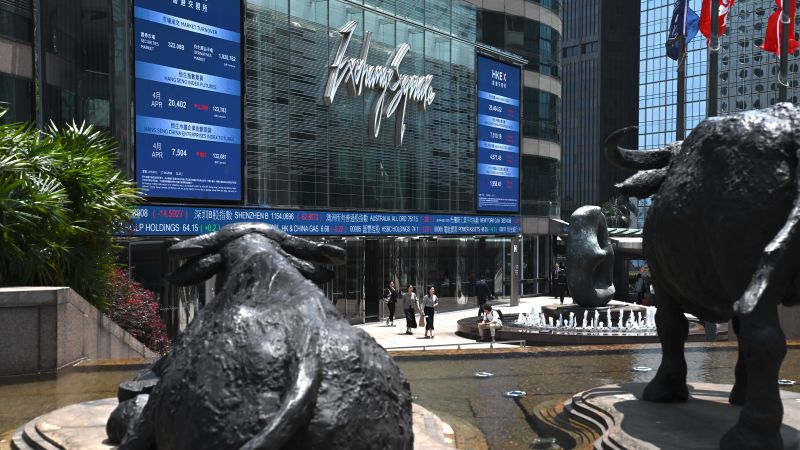
On a turbulent Monday, stock markets across the Asia Pacific region experienced significant declines. The Hang Seng Index in Hong Kong plummeted by 2.4%, while the Shanghai Composite Index dropped 1.6%. South Korean and Taiwanese markets weren’t spared either, with losses amounting to 1.5% and 2.3%, respectively. Meanwhile, Australia’s S&P/ASX 200 felt a decline of 0.5%. These drops are largely attributed to rising fears surrounding a renewed trade war between the United States and China, a situation exacerbated by recent rhetoric from President Donald Trump threatening substantial tariffs on Chinese imports.
The Rare Earths Dilemma
Trump’s pronouncement of potential triple-digit tariffs comes on the heels of China’s recent tightening of its control over rare earth materials. These minerals are crucial for manufacturing electronics, automobiles, and semiconductors, industries where China dominates the supply chain. The U.S. had already initiated its own set of export controls targeting China in late September, despite what seemed like progress in trade negotiations over the summer.
China’s impending restrictions on rare earth exports, which are not scheduled to take effect until November, could have disastrous effects on East Asian economies including Japan, South Korea, and Taiwan—nations integral to the global tech and automotive supply chains.
A Quick Recap of Recent Developments
President Trump reacted strongly to what he deemed China’s "hostile" actions, declaring his intent to impose an additional 100% tariff on Chinese goods starting November 1. This would escalate total duties on imports from China to nearly 130%, nearly an economic embargo reminiscent of the peak tariffs observed during the prior trade war.
The ramifications of these decisions were immediately visible in U.S. markets, which suffered steep drops. The S&P 500 and Nasdaq recorded their worst performances since April, with the Dow Jones experiencing its sharpest fall in months.
China’s Counterattack
Responding to Trump’s threats, China’s Ministry of Commerce stated on Sunday that the country is not intimidated by a trade war. They called for negotiations rather than further escalations, while defending the new rare earth rules as a “legitimate move.” The ministry pointed fingers at the U.S. for the recent tensions, emphasizing that the U.S. had also imposed restrictive measures shortly after recent trade talks in Madrid.
Shifting Tones in Washington
In an interesting twist, the tone from the Trump administration appeared to soften slightly, opening up avenues for renewed discussions. Trump conveyed in a post on social media that the U.S. aims to help China, a stark contrast to his previous comments. "Don’t worry about China; it will be all fine!" he reassured his followers, though specific details regarding this optimistic outlook were lacking.
Market Sentiments and Future Outlook
Despite the initial market turmoil, there was a glimmer of hope as U.S. stock futures bounced back following Trump’s more amiable comments. Dow futures recorded a rise of 0.87%, while the S&P 500 and Nasdaq futures followed suit with increases of 1.33% and 1.86%, respectively.
Vice President JD Vance also weighed in, urging China to “choose the path of reason," asserting that the U.S. possesses a stronger negotiating position. "It’s going to be a delicate dance," he remarked, pointing out that much will depend on how China responds to the unfolding situation.
As trade negotiations between these two global giants heat up once again, the world watches closely. The dynamic nature of these economic conversations could reshape not only the U.S. and Chinese economies but also the broader global economic landscape. This is an unfolding narrative, with updates expected as new developments arise.



