

Global Markets Hit a Rough Patch Amid AI Valuation Concerns
HONG KONG — On Wednesday, international markets faced significant turbulence as fears surrounding the inflated valuations of artificial intelligence (AI) and tech companies precipitated a widespread sell-off across the Asia-Pacific region. The fallout was felt immediately, with investors reacting to speculative pricing that some analysts deem unsustainable.
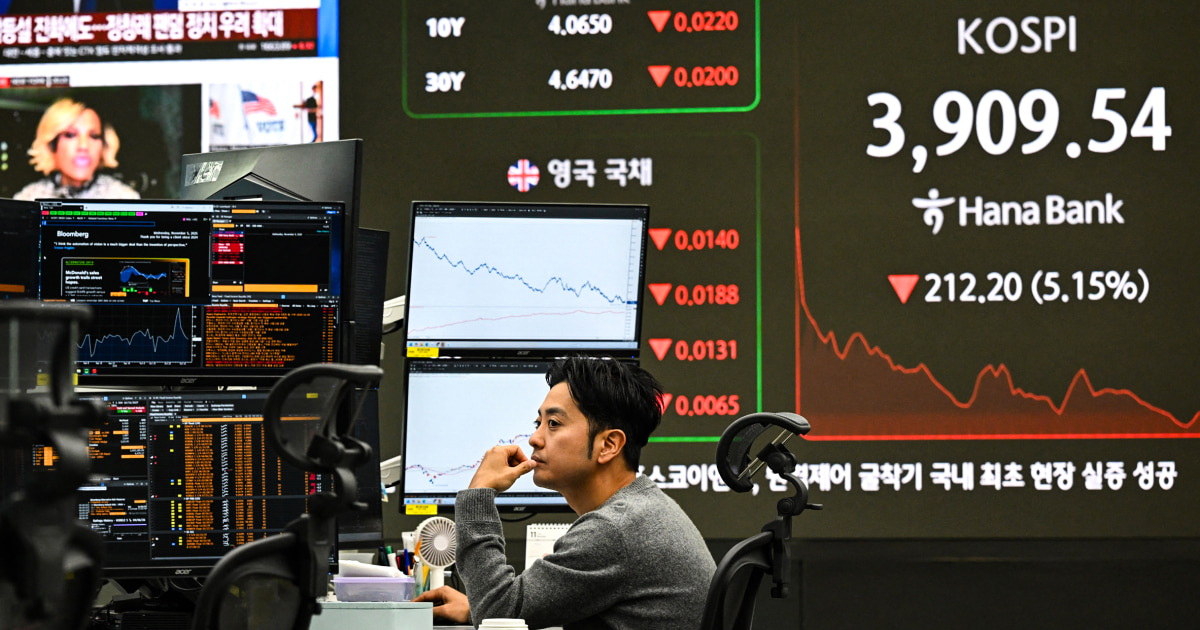
The Kospi index in South Korea experienced a notable plunge, with declines exceeding 6% at one point, a stark reminder of the market’s volatility. Meanwhile, Japan’s Nikkei 225 tumbled by about 4.5%, and the Hang Seng index in Hong Kong dropped over 1%. Taiwanese markets were not spared either, registering a decline of around 2.5%. This widespread downturn marked a significant shift from the previous weeks of market optimism.
European Markets Follow Suit
As Asian markets closed in the red, European indices opened to a similar fate. The pan-European STOXX 600 fell by as much as 0.7%, while Britain’s FTSE 100 and Germany’s benchmark index saw declines of 0.2% and 0.7%, respectively. Although there was some recovery later in the day, the initial losses raised red flags for investors across the globe.
U.S. Futures Indicate Continued Declines
Looking toward the U.S., stock futures hinted at further losses on the horizon. S&P 500 futures suggested a drop of 0.5%, and Nasdaq futures pointed to a steeper decline of about 1%. This pattern underscored a broader trend wherein market sentiments appeared to echo the anxiety originating from Asian trading floors.
Tech Dependency in Asia
Despite a slight recuperation, all major Asian indices closed lower, emphasizing the extent of the region’s dependency on the success of U.S. tech giants. "There are some Asian economies — Taiwan the most, followed by South Korea — that are really dependent on U.S. tech companies," noted Alicia García-Herrero, chief economist for Asia-Pacific at Natixis in Hong Kong. The performance of countries like Taiwan hinges predominantly on the export of semiconductors and the overarching tech ecosystem that fuels their economies.
A Sudden Shift from Rally to Retreat
This sell-off marks a stark contrast to the recent bullish nature of the markets. Following a significant rally, the S&P 500 had closed down 1.1% on Tuesday, while the Nasdaq saw a larger tumble at 2%. Notably, the share prices for industry leaders took a hit; Nvidia, the world’s largest publicly traded company, saw its stock decline nearly 4%. Even Palantir, an AI-focused firm with a robust earnings report, suffered an almost 8% fall.
"Looking at how much AI stocks have contributed to the whole index, it’s hard to believe that kind of growth is sustainable," García-Herrero remarked, encapsulating the worries surrounding the current market conditions.
The Impact of Overvaluation Warnings
The shift in sentiment can be traced back to cautionary signals from Wall Street, which prompted a wave of selling that halted the recent global rally. Just last week, the Kospi had reached record highs buoyed by investor interest in AI stocks, while Taiwan’s benchmark index had risen by 20% this year, largely thanks to impressive gains from TSMC, a significant chip supplier. However, the optimistic climate quickly changed as warnings about overvaluations reverberated, leading to formidable drops in stock prices for major tech players such as Samsung, which fell 5.5%, and SK Hynix, a chipmaker that experienced a more than 6% decline.
Among those hit hardest was SoftBank, a venture capital titan heavily invested in AI companies. The firm saw a staggering 14% drop in its stock, translating into a market value loss exceeding $30 billion.
Earnings Reports Fail to Inspire Confidence
Matters were further complicated by recent earnings reports, which didn’t meet heightened expectations. Industry giants like Advanced Micro Devices and Super Micro Computer, responsible for manufacturing essential AI-related chips, unveiled lackluster earnings, exacerbating fears of an impending market pullback.
Amidst an atmosphere ripe with anticipation for AI-related innovations, the excitement that once characterized the market is increasingly tempered with caution. Companies from Amazon to Microsoft have amassed tens of billions in deals, drawing attention to questions surrounding the sustainability of these business models and their future funding sources.
The U.S. market’s recent trajectory had been impressive, with the S&P 500 still up more than 15% year-to-date and the Nasdaq Composite boasting a 20% increase. However, as concerns over valuations imprint themselves more closely on investment strategies, the future remains uncertain.
In this complex interplay of market dynamics influenced by technological developments, valuations, and global dependencies, the coming days are sure to test investors’ nerve and strategies as they navigate a shifting economic landscape.



