

Supreme Court Case Could Reshape Electoral Politics in the South
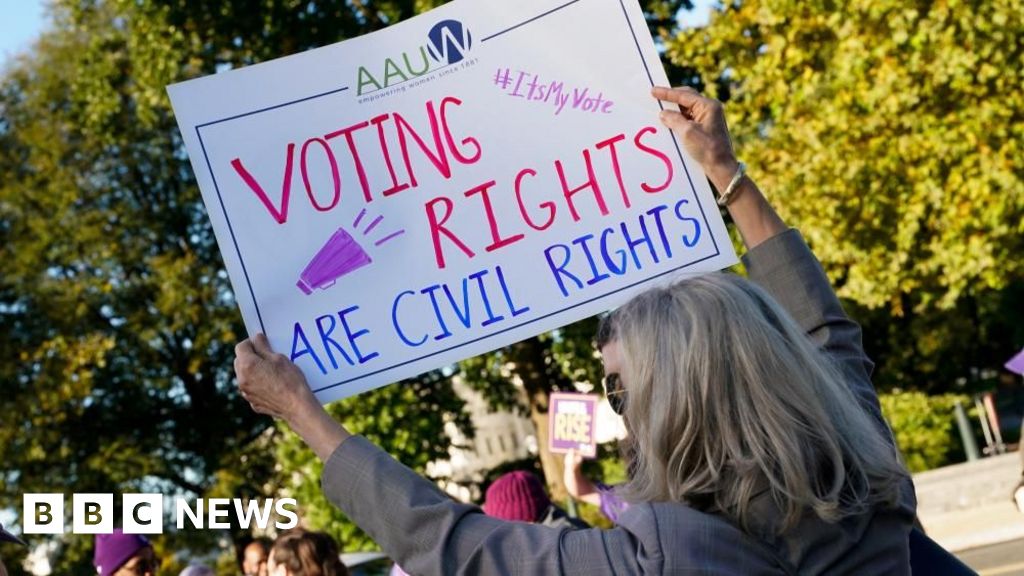
The recent oral arguments at the Supreme Court on Wednesday may herald significant changes to electoral politics in the Southern United States. This case challenges a fundamental aspect of the Voting Rights Act, a historic law aimed at protecting the electoral power of Black Americans against systemic discrimination.
A Shifting Landscape
Originally scheduled for a mere hour, the session extended over two hours, as the nine justices engaged fiercely with attorneys from both sides. Their probing questions suggested that a majority of the court might be open to a profound reinterpretation of this landmark civil rights legislation. A favorable ruling for the plaintiffs could lead to the redrawing of congressional districts across the South, potentially flipping over a dozen seats from Democratic control to Republican, thereby providing a crucial advantage for the GOP in the upcoming midterm elections.
The Stakes Involved
Current projections indicate that such a change may not merely affect individual races but could tip the balance of power in the U.S. House of Representatives. Rick Hansen, a professor of law at UCLA, described the situation as an "earthquake in the American political system," highlighting the far-reaching implications of the court’s decision.
The Case’s Origin
Originating from a lawsuit by Black voters in Louisiana, the case seeks to compel the state to draw a second congressional district with a Black majority. Advocates argue this would better reflect the state’s demographic makeup, where approximately 31% of the population identifies as Black, yet only one out of six congressional districts is majority-Black.
Section 2 of the Voting Rights Act of 1965 explicitly prohibits states from denying voting rights based on race, skin color, or preferred language. This provision has historically required states to create "opportunity districts" to ensure that minority populations can elect representatives that accurately reflect their share of the population.
Changing Political Alliances
The political landscape has shifted dramatically in this case. Initially, Louisiana’s Republican officials defended their congressional map, claiming compliance with the Voting Rights Act. However, they subsequently aligned with the court’s conservative majority, advocating to discard the law’s requirements regarding Black-majority districts entirely. The Trump administration has also thrown its support behind this stance.
Concerns from Advocates
During the oral arguments, Janai Nelson, representing the coalition of Black voters, expressed that abandoning protections from the Voting Rights Act would have "catastrophic" effects. She argued that the current diversity seen in the South is largely due to litigation that enforced the creation of opportunity districts under the Voting Rights Act, stressing the importance of legislative representation for minority voices.
Counterarguments from the State
Louisiana’s Solicitor General, J. Benjamin Aguiñaga, countered this perspective by asserting that the rhetoric surrounding potential consequences was exaggerated. He contended that states would hesitate to significantly alter congressional maps unless doing so threatened entrenched incumbents.
Aguiñaga proclaimed that explicitly factoring in race when drawing district lines constitutes unacceptable discrimination. His arguments echoed reasoning used in a previous major Supreme Court case that invalidated race-conscious admissions policies at Harvard University.
The Court’s Direction
While the court’s ruling may not arrive for several months, initial indications from oral arguments suggest a leaning towards reducing or eliminating current Voting Rights Act requirements. Justice Brett Kavanaugh, often seen as a swing vote, raised concerns about the indefinite duration of the law’s minority-district requirements, and Chief Justice John Roberts appears to be aligning closely with this perspective.
It’s important to note that Justices Clarence Thomas, Samuel Alito, and Neil Gorsuch, known for their conservative views, were notably quiet during the discussions, which further implies they might support the push against current interpretations of the Voting Rights Act.
Implications for Partisan Gerrymandering
The court’s past rulings have allowed states considerable latitude in drawing districts with partisan concerns. This has led to states, both Democratic and Republican, crafting convoluted "gerrymandered" districts aimed at maximizing electoral advantages. However, this has often clashed with the provisions of the Voting Rights Act, particularly as Black voters historically support Democratic candidates more substantially.
Interestingly, the argument presented against the Voting Rights Act’s requirements framed it as “reverse partisan gerrymandering,” positing that protections afforded to Black Democrats are not equaled to those for white Democrats in states where their representation is similarly compromised.
The Ongoing Debate
With the possibility of a decision looming on the horizon, the nation watches as the complexities surrounding the Voting Rights Act and its interpretations unfold in the Supreme Court. The repercussions of this case could prompt a rapid and extensive reconfiguration of electoral boundaries, with the potential to secure partisan advantages that could ripple through future elections.
The intricate dance between legal interpretations, historical precedents, and political maneuvering demonstrates how deeply intertwined the issues of race, representation, and electoral power remain in the American political landscape.



