

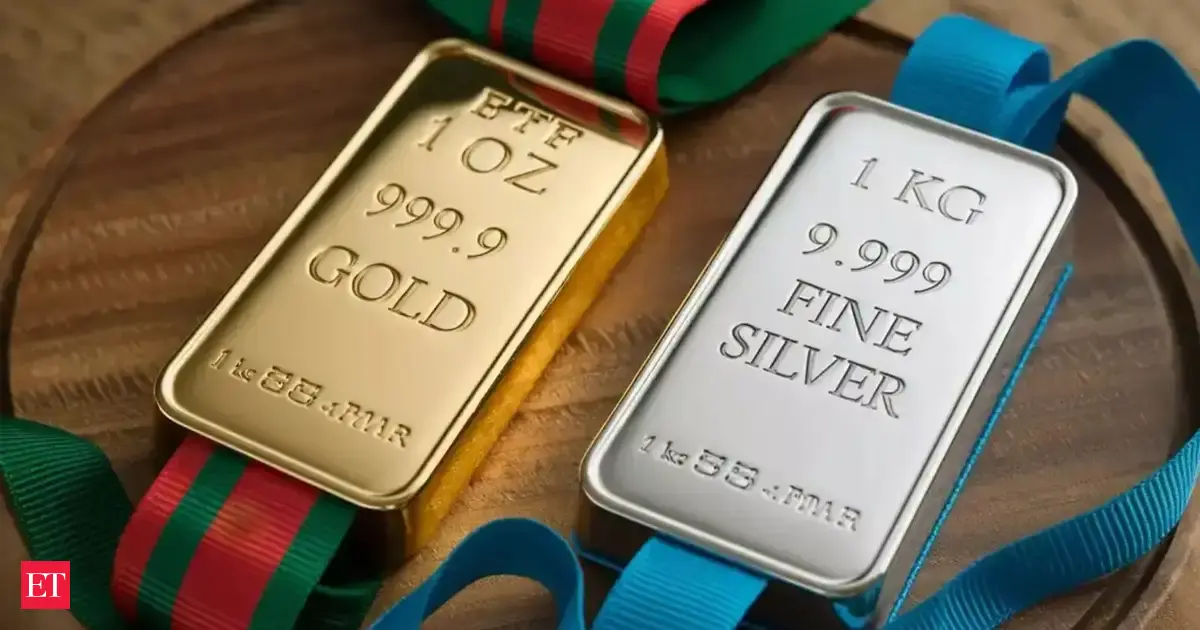
What is Gold and Silver Price Prediction? Future Trends Under Market Pressure
The global metals market is currently undergoing significant turbulence, driven by geopolitical conflicts and fluctuating economic signals. Investors are closely monitoring both gold and silver prices as they navigate through a landscape affected by rising tensions in the Middle East, stronger dollar dynamics, and inflationary pressures linked to energy costs. Recent market behavior has sparked considerable discussions about where these precious metals are headed next: Are we looking at a drop in gold to $3,800 or a rise to $4,800? And what about silver, which could see a decline towards $60 or ascend towards $80?
The Current Landscape for Gold and Silver
Recent trends in gold prices have been decidedly downward, with a notable drop over several sessions that has left many investors anxious. After hitting recent highs, gold prices have retraced significantly, triggering one of the sharpest weekly losses seen in years. The precious metal closed on Friday at $4,508.96 per ounce, marking an 11% weekly decline amidst intensifying geopolitical issues, including military escalations in the Middle East.
On the other hand, silver is also feeling the heat. Currently priced at $68.02, it reflects similar pressures affecting gold, with potential downsides looming. If the selling momentum continues, silver could fall towards the $60 mark, while an eventual recovery could push it as high as $80, contingent upon market conditions and investor sentiment.
Gold and Silver Price Forecasts
Analysts are bracing for a volatile market ahead for both metals, with gold under considerable pressure after sinking from its recent peaks. Current support levels are observed between $4,250 and $4,400. A breach of this range might see prices sliding down toward the alarming level of $3,800. Conversely, if gold holds its ground above $4,400, the potential for recovery exists, possibly pushing it towards the $4,700 to $4,800 range.
Meanwhile, silver’s future is also uncertain. Currently situated at $68.02, it faces headwinds reflective of its golden counterpart. If weakness prevails, prices could trend down to $60, but should momentum shift positively, prices may rally toward the $80 mark.
Factors Leading to Price Pressures on Precious Metals
Understanding the dollar’s strength is crucial to grasping current gold dynamics. A stronger dollar typically dampens international demand for gold, which is seen as a safe haven investment during turbulent times. The continuous conflict in the Middle East is exacerbating issues, with the U.S. ramping up military presence and actions that heighten market anxiety.
Additionally, energy prices, particularly related to geopolitical tensions surrounding the Strait of Hormuz, have begun to surge, further influencing inflation expectations. Such dynamics are pressing many investors to offload positions in bullion-backed ETFs, which have seen significant sell-offs, totaling over 60 tonnes in three short weeks.
Key Levels for Gold Pricing
Currently poised in what analysts describe as a correction phase, gold’s trading levels fluctuate between $4,450 and $4,520. As discussed, strong support zones lie between $4,250 and $4,400. A decline below this range could signal a drop to $3,800 or even $4,000. However, if gold manages to stabilize above $4,400, potential upward movement could guide it towards $4,700 and $4,800.
Experts recommend a buy-on-dips strategy near these critical support levels but caution that short-term upward momentum could be hampered by a robust dollar and ongoing geopolitical developments.
Market Predictions for the Upcoming Week
Forecasting for next week, analysts anticipate that precious metals will continue to face high volatility given existing economic conditions. Expectation remains for elevated interest rates, coupled with persistent energy prices resulting from geopolitical tensions, which will likely sustain pressure on gold and silver.
As market participants track macroeconomic signals—especially concerning inflation and the US dollar—strategies may need to remain adaptable to unforeseen changes in the landscape.
Insights from Analysts and Market Outlook
Analysts note that both gold and silver are navigating through a correction phase after recent peaks. Current market sentiment is decidedly subdued, with a significant emphasis on the dollar’s strength and rising Treasury yields. It becomes paramount for investors to pay close attention to macroeconomic indicators that will dictate the trajectory of both metal prices.
The market outlook conveys that volatility is likely to persist in the near term, with pricing reacting dynamically to geopolitical changes and energy market trends.
Investor Guidance Moving Forward
For those looking to engage in precious metals trading, the prevailing view among analysts is to prioritize strong support levels before making significant investment decisions. A buy-on-dips approach near established support zones is generally favored. Investors are also urged to keep a vigilant eye on prevailing US dollar trends and upcoming inflation data. Given the current volatility, a cautious short-term approach is advisable, while long-term prospects remain bolstered by ongoing macroeconomic uncertainty.
Frequently Asked Questions
Q1. What is the gold and silver price prediction for next week?
Gold is expected to trade within a range of $3,800 to $4,800, while silver may fluctuate between $60 and $80.
Q2. Why are gold and silver prices falling at the moment?
The decline is largely attributed to a strengthening dollar, increased Treasury yields, outflows from ETFs, and inflation expectations driven by global conflicts impacting market sentiment.



