

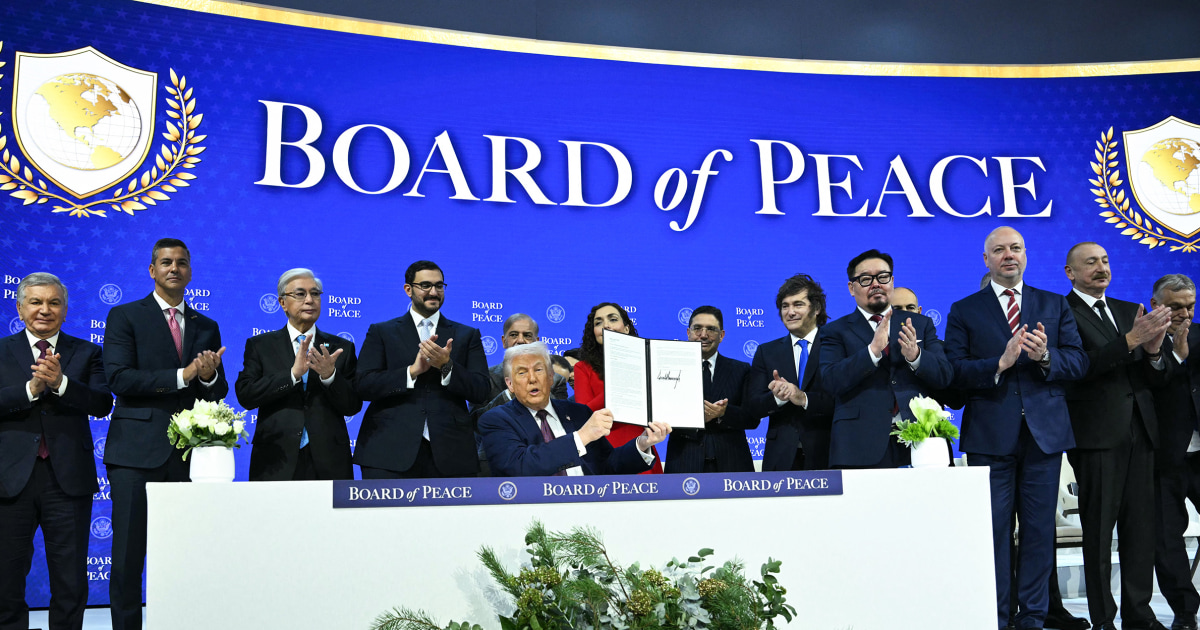
Trump’s Board of Peace: A New Era in Global Diplomacy?
On Thursday, President Donald Trump’s much-anticipated “Board of Peace” convened in Washington, D.C., focusing on the delicate ceasefire in Gaza. The location was significant—the U.S. Institute of Peace—a nod to the board’s ambitious aim to tackle global conflicts. Although the meeting was set to draw representatives from at least 40 countries, notable absences raised eyebrows and questions about the board’s credibility.
Who Was There?
The summit was marked by the attendance of several world leaders, including Hungarian Prime Minister Viktor Orbán and Argentinian President Javier Milei, both well-known allies of Trump. U.S. representation included Trump himself, Vice President JD Vance, Secretary of State Marco Rubio, the Special Envoy Steve Witkoff, and Trump’s son-in-law and senior adviser, Jared Kushner. The atmosphere was reminiscent of a campaign rally, complete with Trump’s favorite anthem and red MAGA-style hats emblazoned with “USA.”
The Message of Peace
In his remarks at the summit, Trump described the initiative as “very simple—peace.” He acknowledged, however, the complexities involved, emphasizing that while peace is an “easy word to say,” producing it is much more challenging. This sentiment of optimism was palpable in his speech, as he labeled the board’s mission as one of the most consequential endeavors he would undertake.
Plans for Gaza
Trump’s agenda includes announcing a multi-billion-dollar reconstruction plan for Gaza. An announcement on over $5 billion pledged from various countries is also expected, although detailed information about the pledging nations remains elusive. Additionally, plans for a United Nations-authorized stabilization force in Gaza are slated for discussion, with several countries reportedly willing to send troops to support this initiative.
Controversies and Concerns
While the summit aimed for inclusivity, significant key U.S. allies like the U.K., France, and Norway opted not to participate. Concerns about Trump’s broader ambition to challenge the United Nations and the potential undermining of its peacekeeping role played a role in their absence. The Vatican also declined the invitation, with a representative stating that “the U.N. is primarily responsible for managing these crisis situations.”
White House Press Secretary Karoline Leavitt termed these decisions “deeply unfortunate,” asserting that peace should not be a matter of political contention.
Opposition and Criticisms
Critics have raised significant concerns about the board, pointing to its potential as a “colonial project.” Voices such as Cardinal Pierbattista Pizzaballa stated that it amounted to external entities deciding for the Palestinians, leading to questions about the lack of Palestinian representation on the board. In an environment of rising skepticism, Palestinian President Mahmoud Abbas’ advisor conveyed that the Palestinian leadership rejects the initiative, terming it a temporary arrangement.
The Dynamics of Participation
Interestingly, while countries like India and Egypt committed to participating, others like Canada were excluded. Trump retracted Canada’s invitation after Prime Minister Mark Carney voiced concerns about the current global order. This strategic exclusion highlights the complex dynamics that characterize Trump’s approach to international cooperation.
The Humanitarian Issue
Among the main focal points of the summit was the humanitarian catastrophe unfolding in Gaza. Despite the ceasefire holding, dire conditions have persisted, with many displaced individuals living in makeshift camps. Trump pointed out that the reconstruction of Gaza would include efforts to demilitarize Hamas, a significant sticking point in the ceasefire negotiations.
The Broader Vision
Trump has expressed aspirations for the Board of Peace that stretch far beyond Gaza, aiming for peace on a global scale. He hinted that while the board would interact with the U.N., he believed the international body had fallen short of its potential. The notion that the board could redraw the contours of global diplomacy remains to be seen.
Moving Forward
As preparations advance for the next stages of the Gaza ceasefire and beyond, the future actions of the Board of Peace will be closely watched. Whether this new initiative can genuinely achieve its lofty goals amidst skepticism from allies and critics alike remains an unanswered question as discussions continue.



