

Asian Market Update: A Mixed Start Amid Economic Concerns
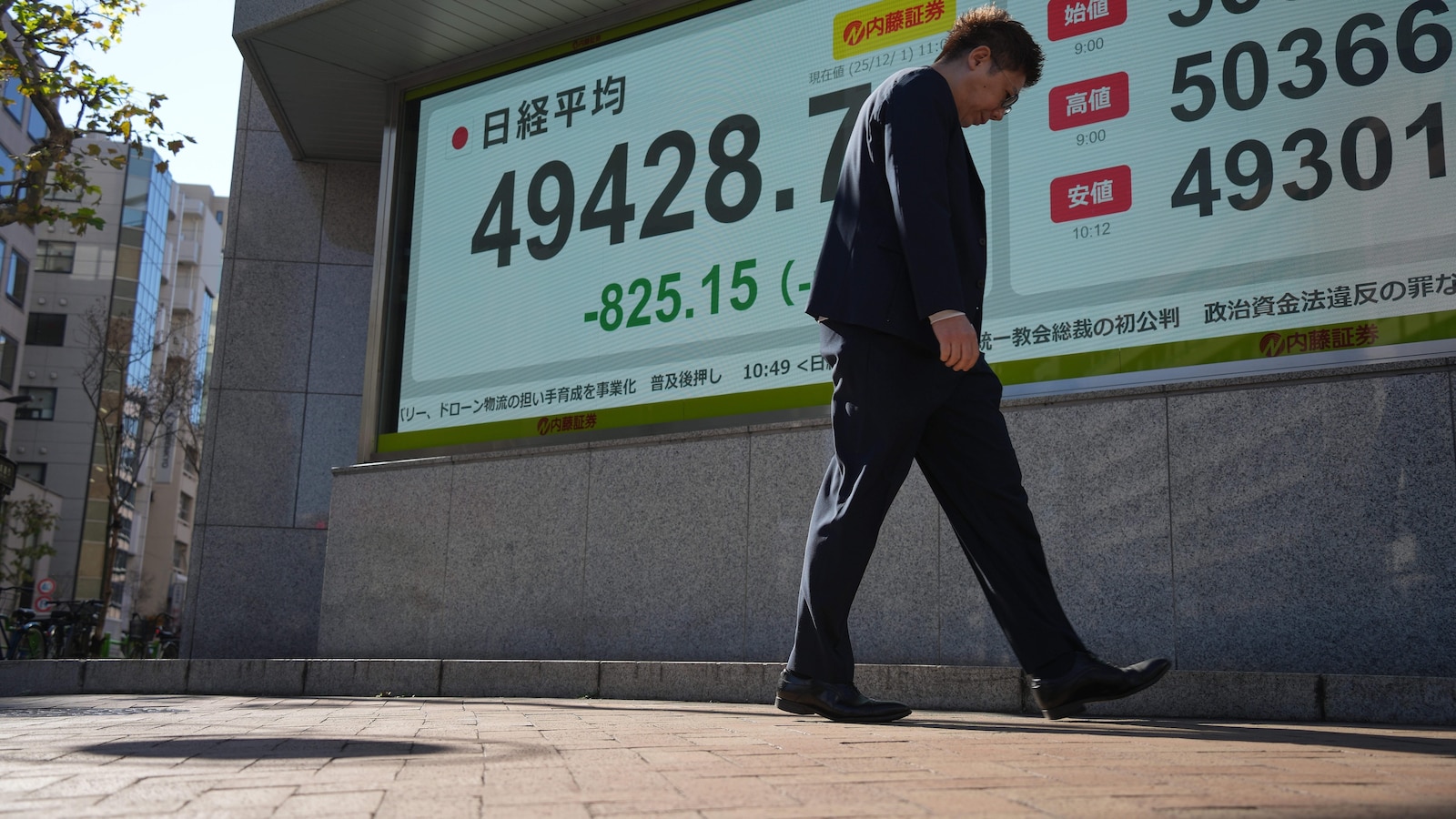
BANGKOK – As the new week unfolds, Asian shares are showing a mixed performance, reflecting the undercurrents of economic concerns. On Monday, Japan’s Nikkei 225 took a notable hit, dropping nearly 2% following disappointing factory activity data, while U.S. futures also pointed downward, signaling a cautious start to the week.
Japan’s Economic Indicators
The Nikkei 225 index declined by 1.9%, settling at 49,285.66. This downturn was prompted by the release of weaker-than-expected corporate investment figures from the Japanese government. As companies struggle to find footing amidst fluctuating economic conditions, the implications for the manufacturing sector are particularly concerning.
A recent survey highlights a significant slowdown in Japanese factory activity. The S&P Global Japan Manufacturing Purchasing Managers Index (PMI) registered a reading of 48.7 for November, a slight improvement from October’s 48.2, yet remaining firmly in contraction territory. A PMI reading below 50 signals shrinking activity, revealing persistent challenges in Japan’s economic climate.
Broader Asian Economic Landscape
Japan’s situation is part of a broader narrative across Asia, where regional manufacturing reports are under close scrutiny. Analysts are particularly keen to assess the impact of former U.S. President Donald Trump’s increased tariffs, which have cast shadows over Asian economies. In China, factory activity has contracted for the eighth consecutive month, underscoring the ongoing difficulties faced by the industry, despite a temporary trade truce with the U.S.
Hong Kong’s markets, however, provided a silver lining as the Hang Seng Index climbed by 0.8%, reaching 26,068.05. Despite this, major players like Meituan suffered, with reports of a net loss in the last quarter due to fierce competition in the delivery sector, pushing its shares down by 1.5%.
Regional Market Reactions
The Shanghai Composite index showed signs of resilience, gaining 0.4% to 3,904.90. Meanwhile, in Korea, the Kospi remained relatively stable, showing minimal change at 3,926.20. Australian stocks reflected a subtle decline, with the S&P/ASX 200 down by 0.3%. In Taiwan, the Taiex fell 0.5%, although the Sensex in India managed to nudge up by 0.3%.
Despite the overall mixed performance, there are encouraging signs. Exports from the region have shown a rebound in recent months, highlighted by comments from Shivaan Tandon, an economist for Capital Economics, noting that while PMIs reflect sluggish activity, there is a glimmer of hope in export numbers.
The Impact of Consumer Behavior
In the U.S., there are expectations that consumer spending during the recent Black Friday and Cyber Monday sales would surpass forecasts, even amidst economic uncertainty. Early indicators pointed towards robust holiday spending, offering potential relief to slowdowns in manufacturing and trade.
However, early Monday morning trading showed U.S. futures down nearly 0.7% for the S&P 500 and 0.4% for the Dow Jones Industrial Average. The backdrop to this mixed sentiment stems from a recent technical glitch at the Chicago Mercantile Exchange that halted trading for several hours last Friday.
Developments in Technology and Market Sentiment
Tech stocks played a pivotal role in shaping market dynamics, particularly after last week’s optimism surrounding potential Federal Reserve rate cuts. Yet, stocks like Nvidia and Oracle witnessed declines, with Nvidia dropping 1.8% and Oracle sinking 23% in November. In contrast, Alphabet emerged as a standout, gaining nearly 14% due to excitement surrounding its new Gemini AI model.
The Federal Reserve continues to navigate challenging waters, balancing the need for economic support amid rising inflation and a slowing job market. The minutes from the Fed’s recent meetings indicated a divide among policymakers regarding future interest rate decisions.
Observing Commodity Markets
In commodity markets, oil prices surged by more than $1 per barrel early Monday, indicating heightened demand in the global market. U.S. benchmark crude and Brent crude both gained $1.05 per barrel. In currency movements, the U.S. dollar fell against major currencies, with the Japanese yen trading at 155.57, down from 156.14, and the euro rising to $1.1602 from $1.1596.
The cryptocurrency landscape also faced volatility, with Bitcoin dropping 5.3% to a value of $86,225, highlighting fluctuations that are commonplace in the digital currency market.
Closing Thoughts
As the week progresses, the mixed performances across Asia and fluctuations in key global indices will surely capture the attention of investors. Understanding these interconnected economic factors can provide insight into the developing landscape not just in Asia, but globally.



