

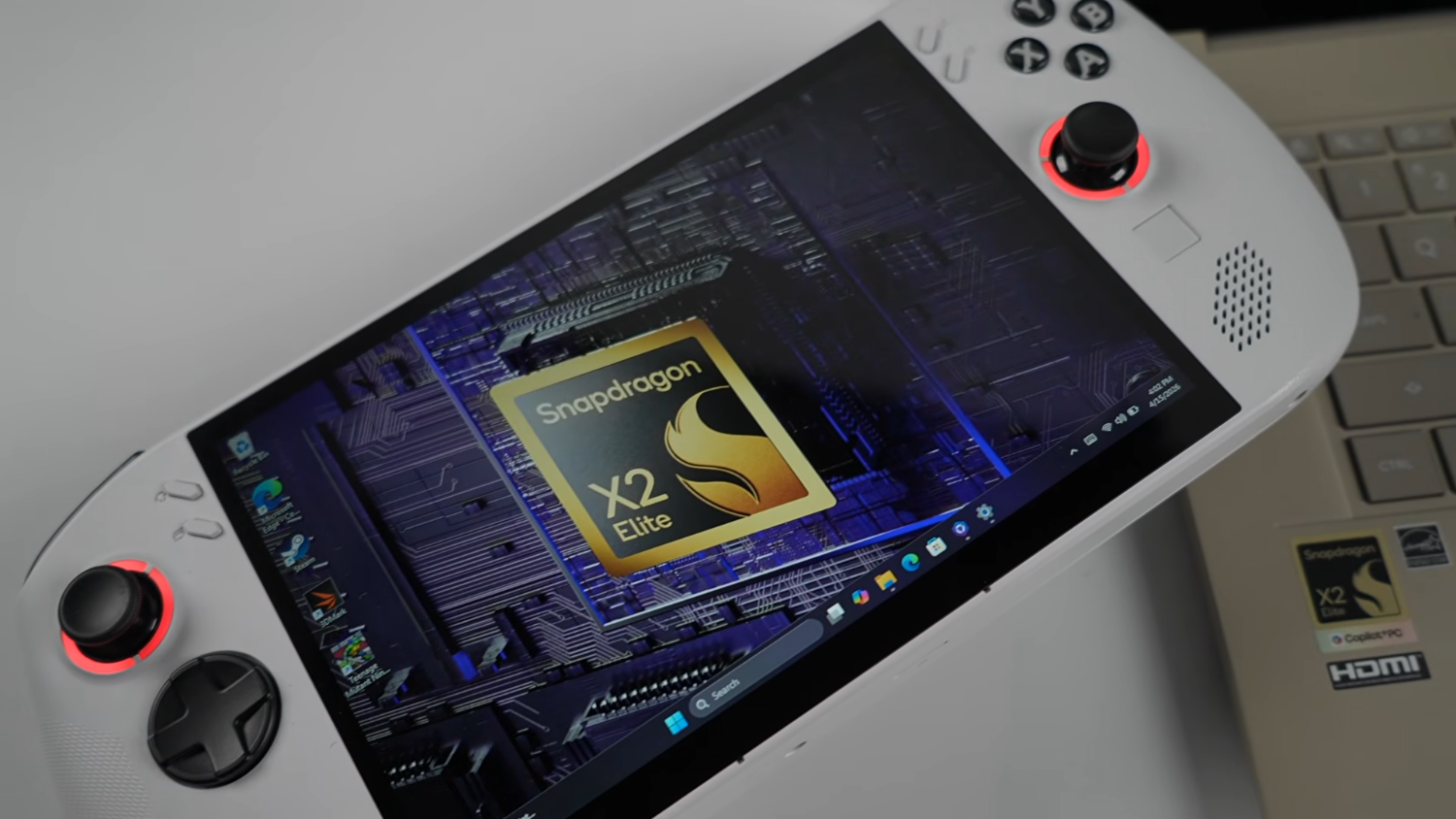
Qualcomm Snapdragon X2 Elite: The Future of Handheld Gaming?
The gaming landscape has always been heavily influenced by the performance capabilities of its chips, and Qualcomm’s Snapdragon X2 Elite series has emerged as a notable contender in this arena. Competing with established giants like Intel and AMD, the X2 Elite has showcased impressive power and efficiency, yet remains conspicuously absent from handheld gaming PCs. A recent exploration by YouTuber ETA Prime sheds light on just how well the X2 Elite could perform in such devices, especially when tested in low-wattage mode.
Testing the Snapdragon X2 Elite
In his latest video, ETA Prime scrutinizes the Snapdragon X2 Elite Extreme X2E94100 chip, which boasts capabilities of up to 4.7 GHz. He pairs this processer with a robust 48GB of RAM operating at nearly 9600MT/s. The chip’s performance can be toggled between three distinct power modes: performance mode (up to 60 watts), balanced mode (45 watts), and low-power mode (16-23 watts). The video aims to simulate a handheld gaming experience, providing a groundwork for understanding how the X2 Elite might perform in portable consoles.
Impressive Gaming Performance
ETA Prime conducted tests on a variety of titles, including heavyweights such as Red Dead Redemption 2, Cyberpunk 2077, Ratchet and Clank: Rift Apart, Japanese Drift Master, and Mortal Kombat. The results were illuminating.
-
Red Dead Redemption 2 managed to hit approximately 75 FPS in performance mode at 1080p high settings, a commendable feat. Interestingly, the game still held its own with just under 60 FPS in low-power mode at 720p high settings.
-
Cyberpunk 2077 displayed around 65 FPS at 1080p high settings in performance mode, with a similar frame rate in low-power mode at 720p.
-
The vibrant world of Ratchet and Clank: Rift Apart also performed admirably, achieving approximately 68 FPS at 1080p medium settings in performance mode, consistently holding similar frame rates in low-power mode.
-
Even genres like racing were not left behind; Japanese Drift Master ran smoothly at around 60 FPS in both performance and low-power modes.
- Lastly, Mortal Kombat demonstrated its prowess, running at a stable 60 FPS in both modes at 1080p medium settings and 720p high settings, respectively.
These results indicate that the Snapdragon X2 Elite’s efficiency supports a playable gaming experience within the modest power envelopes commonly seen in handheld devices, typically hovering around 17-20 watts.
Comparing the Competition
For context, ETA Prime highlighted the performance of competitors. Handhelds utilizing the AMD Ryzen Z2 Extreme—like the MSI Claw—struggled to achieve over 55 FPS in Cyberpunk 2077 at the low power of 17 watts using the game’s lower graphical settings. The disparity between the X2 Elite series and the Ryzen Z2 Extreme paints a picture of what Qualcomm’s chip may offer to gamers seeking a portable solution.
As for comparative benchmarks, at a slightly higher and more performant 30W envelope, the X2 Elite has put forth competitive scores against chips like Apple’s M5 and Intel’s Core Ultra X7 series, highlighting its versatility and potential.
The Challenges Ahead
Even though the Snapdragon X2 Elite shows promise, the path to its successful integration into handheld devices is fraught with complications. One major hurdle continues to be gaming reliability. As it stands, Qualcomm’s latest SoC has not entirely resolved issues concerning game compatibility, leading to crashes in titles such as F1 25 and Doom: The Dark Ages. Such problems are exacerbated when players use popular overlay tools, which trigger further glitches.
Qualcomm has the technical capability to rectify these issues through GPU driver updates, yet the timeline for these fixes remains uncertain, posing a risk for manufacturers weighing their options.
Battery Life Concerns
With a core configuration ranging from 12 to 18 cores, the Snapdragon X2 Elite and X2 Extreme could be overkill for handheld systems. This surplus processing power could adversely impact battery life, an essential factor for any portable gaming device.
Additionally, the reliance on the ARM-to-x86 Microsoft Prism emulation layer introduces another layer of complexity, possibly leading to increased battery consumption. Given these issues, manufacturers may prefer more straightforward solutions, such as AMD’s Z2 Extreme, which currently presents fewer compatibility issues and avoids the overhead of translating x86 code to ARM instructions.
In Summation
While the Snapdragon X2 Elite series highlights a newfound level of capability in mobile gaming, its integration into handheld devices remains a significant question mark due to various challenges, including gaming reliability and battery drain concerns. As manufacturers contemplate their next moves in the portable gaming arena, the X2 Elite’s future hangs in the balance, promising potential but clouded by uncertainty.



