

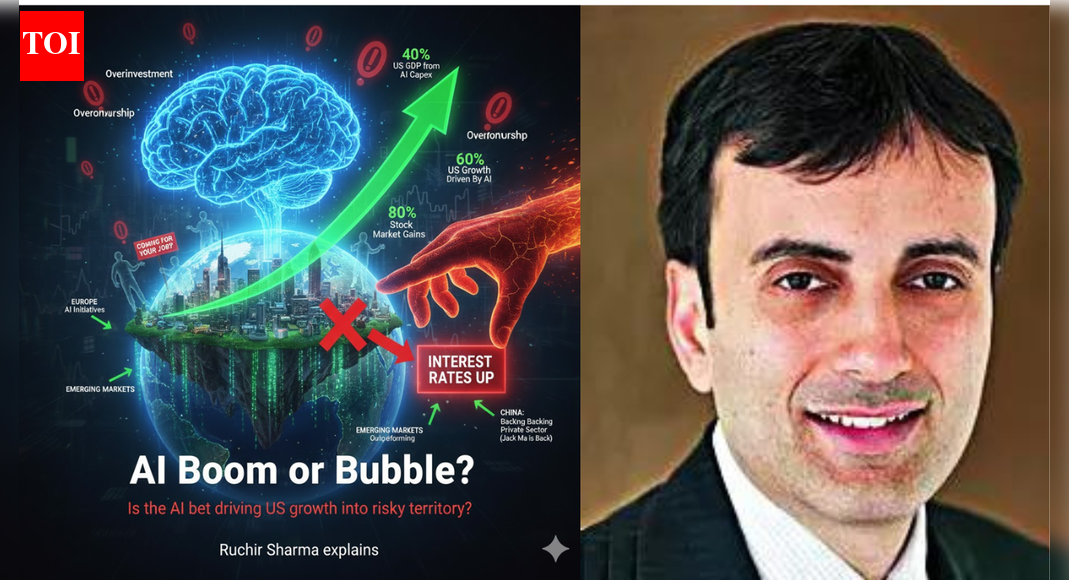
AI Boom or Bubble? Insights from Ruchir Sharma
The rapid rise of artificial intelligence (AI) has transformed the landscape of the global economy, with the United States at the forefront of this technological wave. Ruchir Sharma, a veteran economist and investor, highlights how AI is reshaping markets and driving U.S. growth, but he also raises cautionary flags about the risks involved.
The U.S. Economy and AI: A Singular Focus
During a recent discussion with Nicolai Tangen, Sharma remarked, “This big factor has out-Trumped Trump – AI.” He emphasized that AI has become the “singular focus” of not just the U.S. economy but the global economic landscape. According to Sharma, the U.S. economy is now heavily weighted on AI, with much of its growth dependent on advancements and investments in this sector.
He pointed out that aside from AI, various segments of the U.S. economy show significant weakness. Conversely, Sharma asserted that AI has driven a considerable portion of economic activity, making it a pivotal element of America’s financial health.
AI’s Impact on Economic Growth
Sharma’s analysis reveals that a staggering 40% of U.S. economic growth this year has stemmed from capital expenditure related to AI. This figure underscores the extent to which artificial intelligence is currently influencing the economy. He elaborated on the “wealth effect,” where rising stock prices benefit the wealthiest Americans, thus propelling consumer spending.
Sharma notes that the top 10% of earners are driving much of this consumer spending, thanks largely to market gains heavily concentrated in AI investments. In fact, he asserts that approximately 80% of this year’s stock market gains can be traced back to sectors tied to AI, suggesting that up to 60% of the economic growth in the U.S. is being fueled by this technology.
Productivity Gains: A Work in Progress
On the other hand, Sharma remains skeptical about the immediate productivity gains attributable to AI. He referred to AI adoption as still being in its “nascent stage.” Drawing parallels to the internet boom of the late 1990s, he noted that significant productivity improvements often take time to materialize.
“Very little [of the productivity improvement] can be attributed to AI as yet,” he stated, highlighting the uncertainty surrounding how AI will ultimately influence various industries and economic performance in the long term.
The Public’s Perception: Fear and Skepticism
Unlike previous technological revolutions that were often met with optimism, the current wave of AI has engendered significant public apprehension. Sharma remarked, “This is the most hated tech revolution,” based on surveys indicating that only about 35% of people have a positive outlook on AI. Many are concerned about job displacement and the unknown implications of emerging technologies.
This skepticism is compounded by fears that AI may rapidly change workplaces in ways that many are not equipped to handle. As Sharma poignantly noted, while techno-optimists are advocating for the merits of AI, the broader public remains wary, calling for increased regulation in response to their fears.
Market Signals: The Bubble Question
Despite recognizing the promise of AI, Sharma characterizes its current state as a “good bubble,” cautioning that there are multiple signals indicating potential market instability. He outlined what he refers to as the “four O’s” that are symptomatic of this bubble: overinvestment, overvaluation, overownership, and overleverage.
For instance, the proportion of tech investment relative to GDP currently stands at about 5%, reminiscent of the late 1990s before the dot-com crash. Furthermore, Sharma points to inflated market valuations, arguing that while traditional metrics like price-to-earnings ratios may not yet mirror those of the dotcom era, alternative measures signal approaching danger.
Interest Rates: The True Catalyst
As with many historical market bubbles, Sharma warns that rising interest rates typically serve as the trigger for downturns. He expressed concerns about the Federal Reserve’s handling of current inflation trends, which have consistently surpassed its 2% target.
By observing trends in interest rate adjustments, Sharma suggests that a sudden increase could puncture the burgeoning AI bubble, potentially leading the U.S. economy into turmoil should the optimistic trajectory falter.
Global Markets: A Shifting Landscape
Interestingly, Sharma observes that U.S. markets have underperformed compared to those in Europe, emerging markets, and even China. Contrary to expectations of American exceptionalism at the start of the year, global equities have painted a different picture, with regions outside the U.S. demonstrating stronger performance.
He attributes this shift to a combination of extreme positioning and reformative actions taken in European markets, where countries like Germany are beginning to course-correct.
China’s Private Sector: A Necessary Shift
Turning to China, Sharma notes the country’s economic challenges that lie beyond AI. With a struggling property market, he points out that China has recognized the need to revive its private sector to compete in AI. He emphasized this pivot, with figures like Jack Ma returning to leadership roles, signaling a renewed focus on stimulating growth from the private sector.
Tariffs and Government Role in Capitalism
Sharma also addressed the expanding role of government, describing it as a distorting force in capitalism. He criticized tariffs for lacking objectivity and said they hamper economic growth even while contributing to government revenues. The optimistic narrative surrounding AI has thus masked some of these underlying challenges within the economy.
Quality Stocks: A Contrarian Investment Opportunity
As Sharma looks ahead, he sees potential in quality stocks, which have faced a notable decline in recent months. He argues that this could represent a significant opportunity for investors seeking stable returns in an uncertain market environment.
While cautioning against overly aggressive investments, he suggests a strategic focus on companies that show strong fundamentals. Sharma anticipates that as global markets continue to outperform their U.S. counterparts, the trend may establish itself as a multi-year phenomenon.
Through his insights, Ruchir Sharma invites investors, policymakers, and the public alike to carefully navigate the complexities of today’s AI-driven economic landscape. In doing so, he raises important questions about sustainability, risk, and the future of economic growth.



